Jekyll2026-06-18T03:48:25+00:00/feed.xmlYour awesome titleWrite an awesome description for your new site here. You can edit this line in _config.yml. It will appear in your document head meta (for Google search results) and in your feed.xml site description.How I Built This Website: Vibecoding Edition2026-06-01T00:00:00+00:002026-06-01T00:00:00+00:00/2026/06/01/tutorialIntroduction
I originally wrote this article around three years ago, but I’ve since revamped my website, so I thought it would be fitting to rewrite this article. I started my website in 2018 as a middle schooler with elementary HTML and CSS skills to boot (before the AI era) and the website itself so far went through a hundred git pushes since then. But Claude Code has made this process so efficient, and I’ve gotten my website to a point where I’m happy with it. I will say it is much easier to start with an existing website and iterating on top of it, but I will go over briefly how I started up my website. But I will mostly be outlining how I prompt engineered Claude to give mockups and how I debugged with Cursor! It’s a whole new way of web development and I’m excited to share my journey.
Getting Started
Static Site Generator
Ok, so we have the website made directly from scratch or we have the one made from a static site generator. A static site generator just makes the repetitive task of writing HTML and CSS easier. For example, let’s say that you have 6 different pages on your website and you have a nav bar that you want present on all pages. To insert that, you have to copy and paste that code for the header into each page. Ok, so that doesn’t sound that bad. Although, the bad part is when you have to change a detail in the header, and then you have to change that on all the pages. A static site generator prevents all this so that you can just make your changes in one place and it’ll update on all your pages.
The generator that I use is Jekyll, and I chose this because it’s blog aware. Meaning, that it has a blog template type of thing embedded it’s super easy to download. It takes Markdown files and translates them into webpages, and using Markdown is really efficent and easy to learn along the way.
Of course, there are many other generators, like Gatsby.
Mockups with Claude
Cursor Prompts
Google Analytics
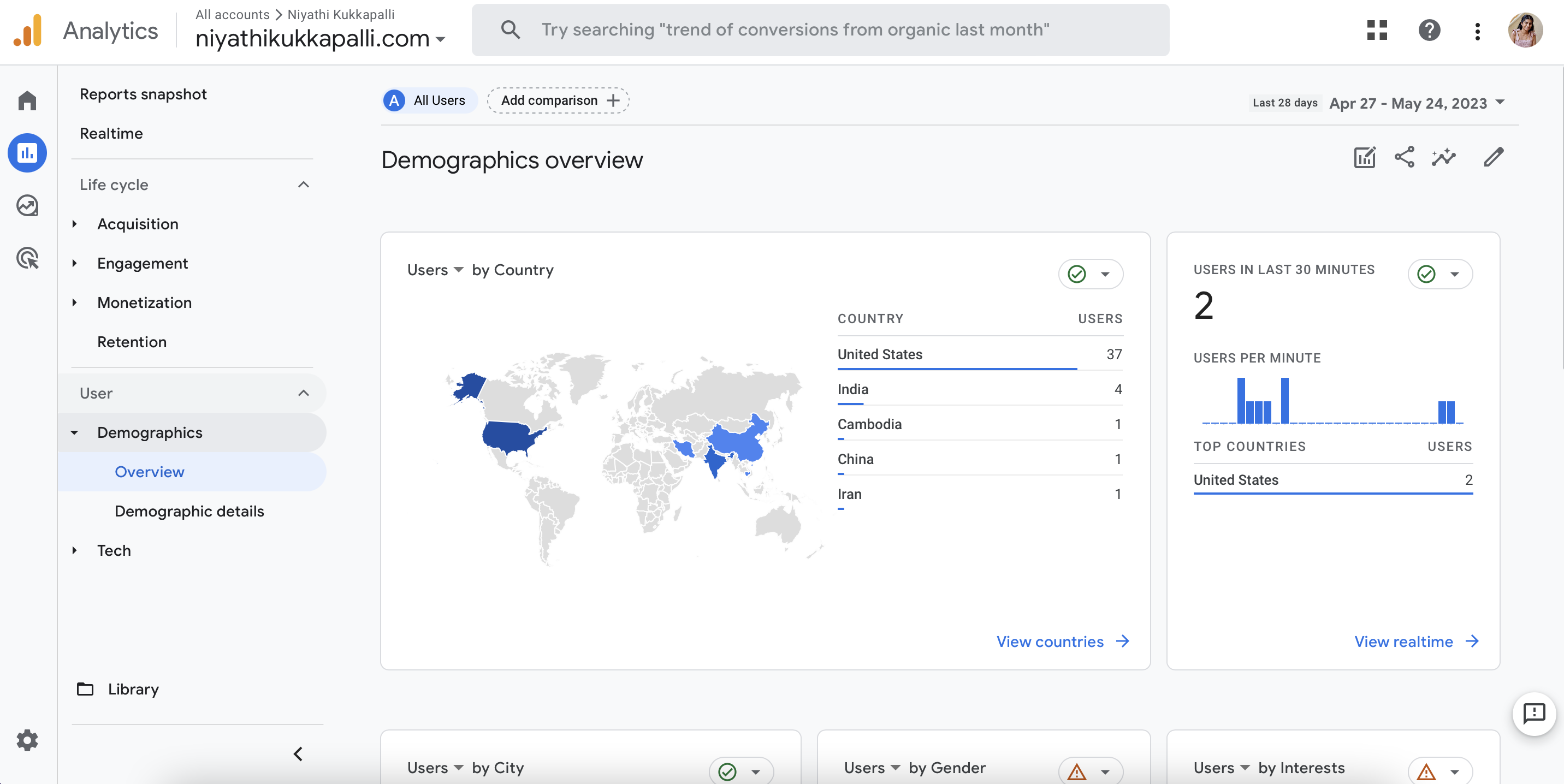
If you have a blog (like me) or a project on your website where you want people to look at it – you probably want analytics. This allows you to look where your viewers are from, how old they are, or most importantly, how many you have. It’s really easy to activate. All you have to do is connect your website url to the website, and then you will see all your stats. Below is an example of what my page looks like …
For example, the one that I use the most is the “Reports snapshot” feature which tells you how many users you’ve had in that week and what countries they are from although it’s hard to discern whether they are bots or not; I’ve gotten a lot from Cambodia recently. It’s pretty addicting to look at the analytics and just see who is looking (when someone besides my friends and family looks I get pretty excited).
Final Thoughts
]]>Inside the Wolfram Student Ambassador Program2024-03-04T00:00:00+00:002024-03-04T00:00:00+00:00/2024/03/04/23-wolframIntroduction
Whether it’s tackling my USAMTS competition problems or that one stubborn Calculus homework question, Wolfram Alpha is genuinely great. I remember plugging in a really complex two-variable system of equations once, and it just solved it. Now, as a mathematician, I’ll admit that might count as shortcutting — but when a system is truly unsolvable by hand, bashing at it endlessly isn’t productive either. And as my appreciation for Wolfram grew, I applied to become a Wolfram Student Ambassador. Back in September, I interviewed with the team and got in!
This article isn’t meant to be a deep dive — I mostly want to highlight some cool things you can do with Wolfram notebooks. Recently I posted an article on Wolfram Community summarizing my physics research and the properties of pendulums you can model with Wolfram. That article earned me a Featured Contributor badge, so I thought it was worth talking about here.
Mathematica
Mathematica is Wolfram’s mathematical computation language, widely used by professionals across STEM. What sets it apart from other tools is that it applies intelligent automation throughout — from selecting the right algorithm to formatting plots and designing user interfaces.
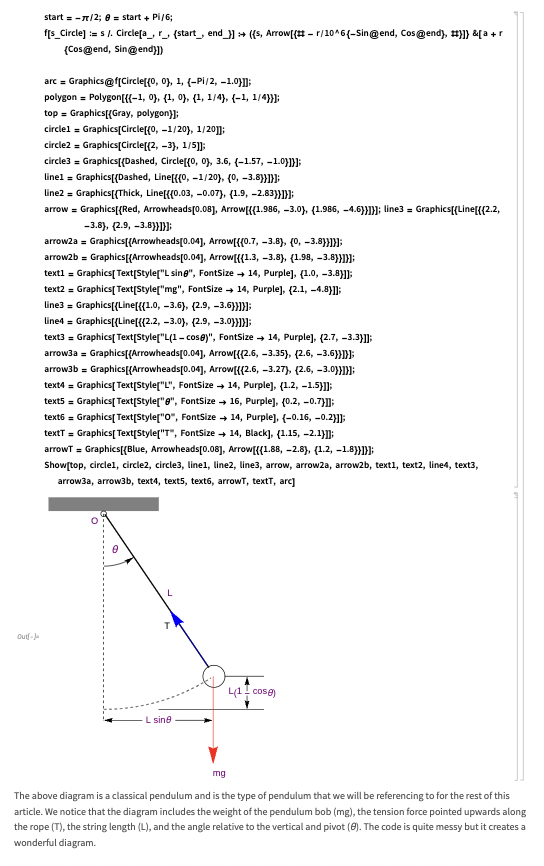
For my Wolfram Community article, I built a pendulum diagram entirely in Mathematica. The code might look intimidating at first glance, but a lot of Mathematica is surprisingly readable — you’re essentially describing what you want in plain terms. I’m specifying which line goes where, how high a circle sits, and so on. The implementation isn’t too advanced, which makes it genuinely beginner-friendly.
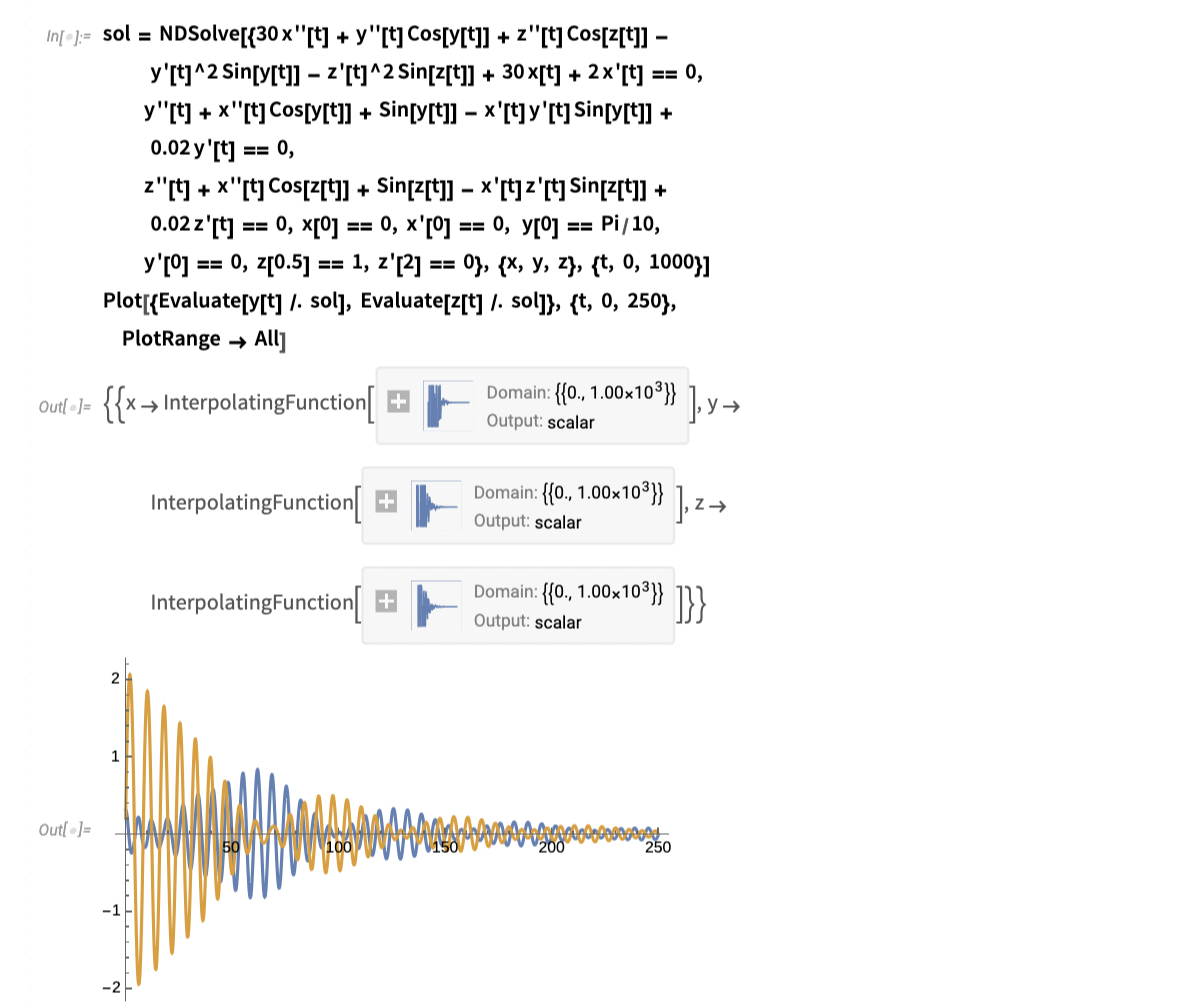
Another block I used in the article might look dense, but for anyone familiar with advanced physics, it’s really just a rewritten Euler-Lagrange equation. I wanted to graph the solutions to a Lagrangian motion equation, and a standard graphing tool like Desmos simply can’t handle that — so Mathematica was the natural choice.
If you want to check out my full article, you can find it here!
Wolfram Alpha
As a prize for placing in the USAMTS competition, I received a year-long subscription to both Wolfram Alpha Pro and Mathematica — pretty nice! Wolfram Alpha is especially useful for those equations that would take forever to solve by hand. Here’s a problem from Year 33 of USAMTS to illustrate:
Problem: Let $x$ and $y$ be distinct real numbers such that
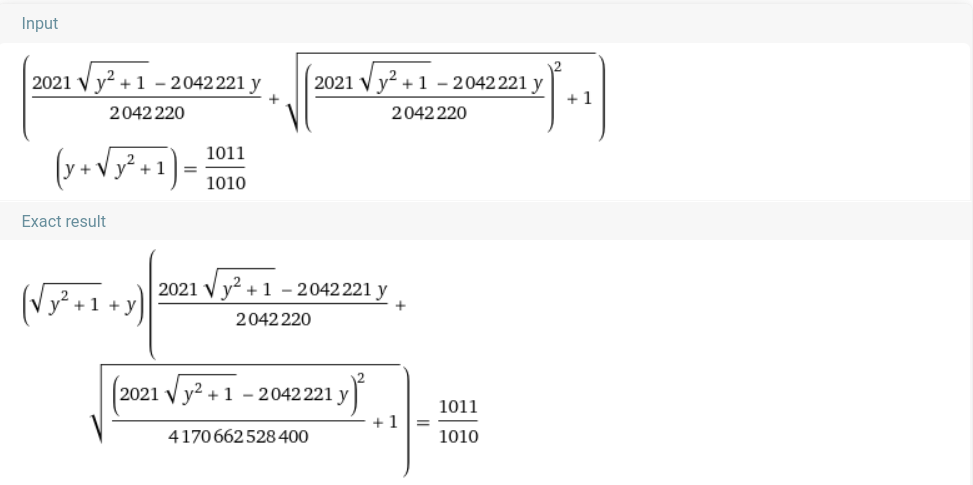
After substituting equation 1 into equation 2, plugging it into Wolfram Alpha gave us the answer right away. I’m sure there’s a more elegant approach, but it’s a great way to check your work.
I currently have Wolfram Premium, which is particularly helpful for things like triple integrals — it walks you through the steps so you actually understand the solution rather than just getting an answer. If you’re a math-interested student, though, I’d encourage you to try placing in USAMTS first — it’s a great way to earn access without paying for a subscription!
Wolfram Player
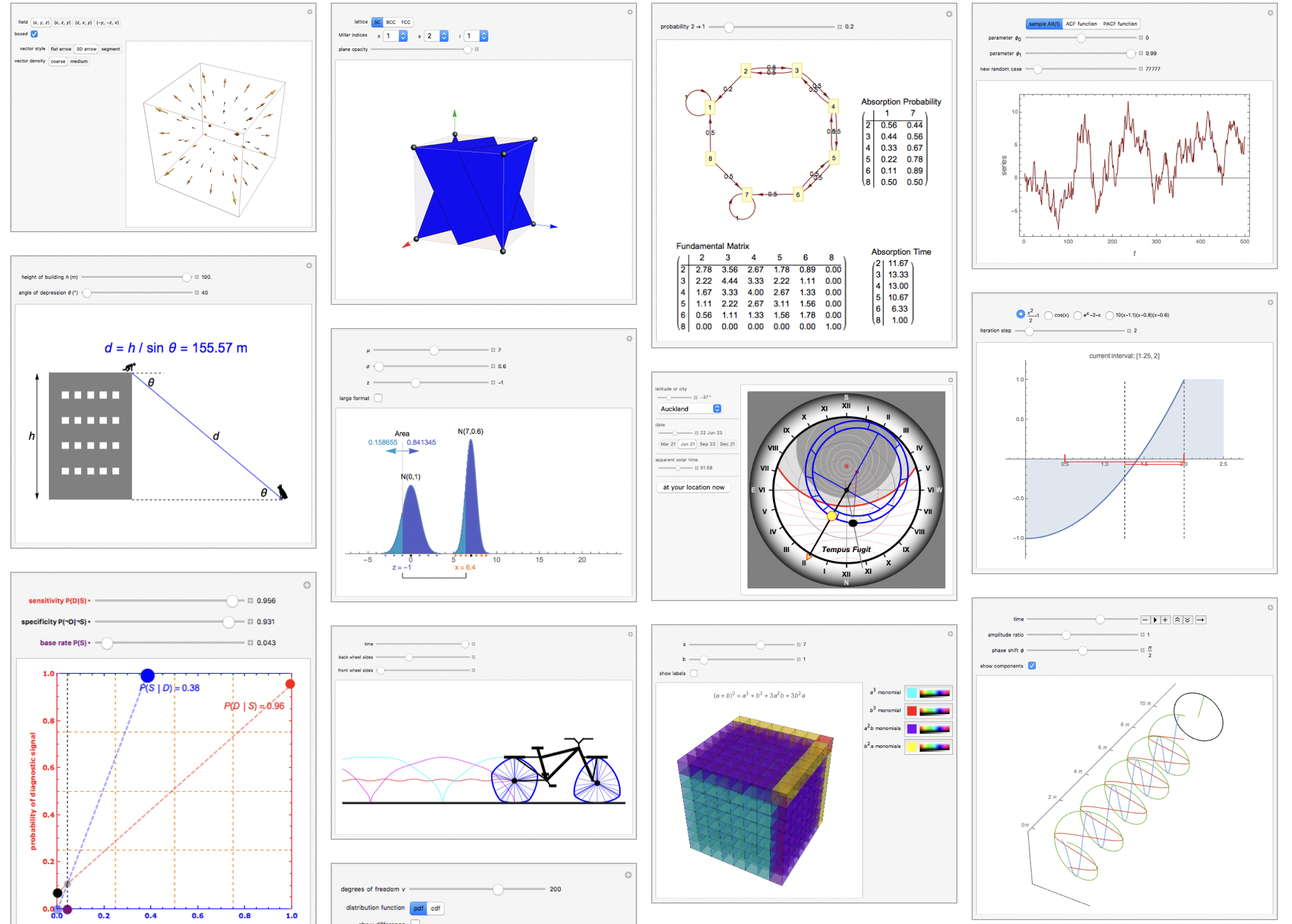
One more thing worth mentioning before I wrap up: Wolfram Player. I used it during my research project as a way to build animations and simulations in Wolfram Language. Other software options either cost money or eat up a lot of storage, so Wolfram Player was a great alternative. There’s a whole archive of community-made demonstrations on the Wolfram website, and some of them are incredibly intricate — well worth exploring.
Conclusion
Wolfram is genuinely impressive, and learning Mathematica or Wolfram Language will be useful whether you’re a student, a researcher, or just someone who enjoys solving hard problems. Wolfram has plenty of practice guides online, and working through any of them will give you a solid foundation. Stay tuned for the next article!
]]>The Weight of Error — How Mistakes Shape History More Than Plans2023-10-08T00:00:00+00:002023-10-08T00:00:00+00:00/2023/10/08/23-lockeIntroduction
I recently entered the John Locke Institute Global Essay Competition which is held by the John Locke Institute sponsored by Oxford and Princeton. It’s an essay competition that encourages you to explore college level academic writing through thought provoking questions that go beyond the bounds of school essays. You can receive many prizes through the competiton, and I myself got a Commendation for the essay I submitted into the History section.
While this deviates a bit from my usual content, I find that it’s actually really similar to writing a research paper, but just in a different subject. You still have to research the topic, cite references, be specific, etc. For anybody looking to enter next year, my essay is down below to see what academic writing for a thought provoking question is like.
Which has a bigger effect on history: the plans of the powerful or their mistakes?
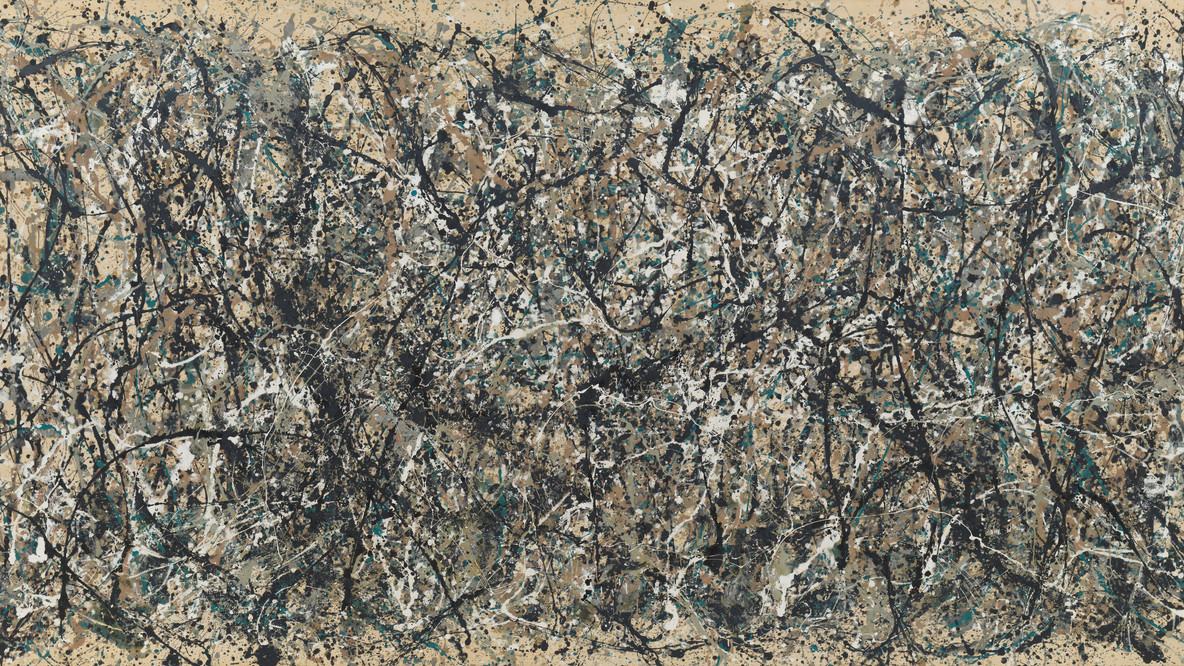
Imagine Jackson Pollock’s works: he was famous for his widely used “drip technique” to create drip artworks (Google Arts and Culture, n.d.). He utilized a can of paint and artfully dripped the paint onto a horizontal canvas. From that, would you argue that his paintings are mistakes or planned? He doesn’t know where the paint exactly goes, so is it a mistake? He would move back and forth across his sprawling canvas, directing the paint onto the areas he felt it needed to be. As he moved back and forth, he would adjust his plan according to how the paint naturally fell. We might say that the powerful don’t know exactly where the paint may fall when it leaves their brush, but each flick of the wrist and each movement along the canvas has a purpose. Mistakes, regardless if made by the powerful or not, are the opportunities that other powerful people take advantage of in order to make plans that change history.
Jackson Pollock's drip technique, referenced in the opening analogy.
We can interpret the question as such: do the powerful rewrite history or is history written on their mistakes? After defining needed terms, and analyzing various historical contexts in international affairs from the past century, we can logically assess the effects of plans and mistakes based on European philosophy. I will demonstrate this by asserting the intertwined relationship between mistakes and plans overlaid with the events of the World Wars and their effects. I contend that the World Wars and some of their effects left the largest imprints in history, and it’s demonstrated that they are all plans of the powerful. By following this argument, I propose that the plans of the powerful have a bigger effect on history than their mistakes.
To begin, we elucidate the difference between mistakes, effects, and power. A mistake is an action that could be perceived as wrong based on precedents: previous wars or events in this case. A direct consequence of this definition is that a mistake is also considered a matter of perspective. For instance, the Vietnam War was fought during the Cold War in the 1960s and 70s over advances of communism and resulted in more than a million deaths (Spector 1998). Some consider it a mistake from the sheer number of lives lost, but others thought it was a necessary measure in the Cold War and aided the effort to permeate democratic values throughout Asia. It’s clear both mistakes and plans can exert a profound influence on written history, and these effects fall into two categories: indirect and direct. Indirect effects are events propagated from another event, like how decolonization of nations was an effect of the Bolshevik Revolution. Although, in order to avoid any logical fallacies, this paper considers only direct effects or very close indirect effects. By definition, Vladimir Lenin is powerful: he had “control and influence over people and events” (Oxford Dictionary n.d). He created a plan, starting with overthrowing the Russian monarchy to then establish a communist government (Britannica 1998). Generally speaking, employing a plan is a method for achieving some end even if those intentions or effects prove to be disastrous. Lenin’s plan ignited a chain reaction instigating the stage for some of the most influential cultural reforms, such as Third World nationalism and globalization (Britannica 1998). To precisely determine the extent of a “bigger effect”, this paper measures how many are positively or negatively affected by a plan or mistake.
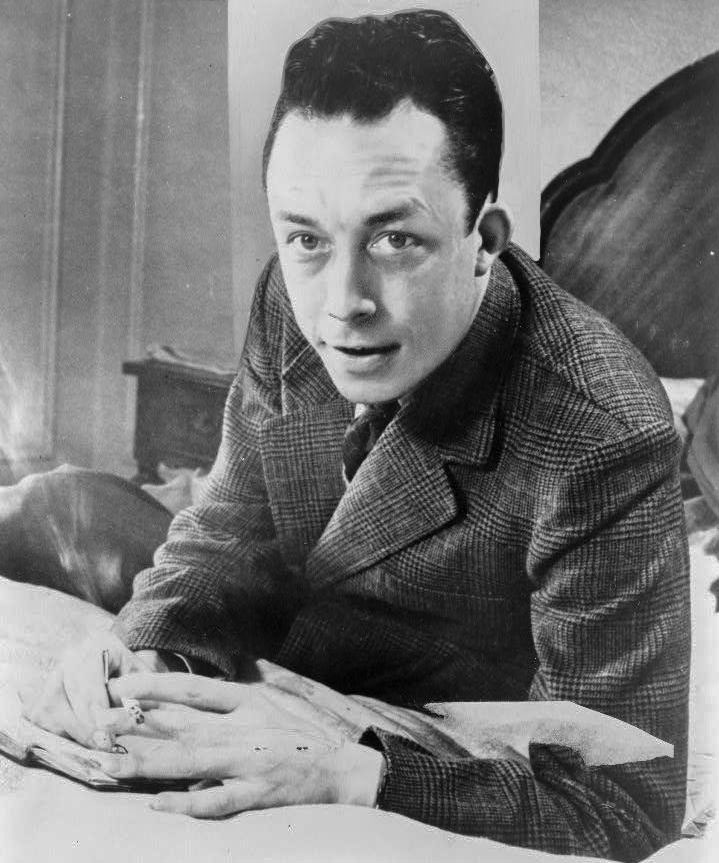
As the French philosopher and Nobel Laureate Albert Camus stated in his book The Plague, “good intentions may do as much harm as malevolence, if they lack understanding” (Stewart 2011). It’s interpreted that mistakes can do as much harm as malevolence, but not necessarily that they are malevolent. Camus’s philosophy brings into question whether a certain plan that lacks understanding can be classified as a mistake. This would make sense, as a plan that failed to understand precedents and proceeded in spite of them is definitely a mistake. For this paper, certain plans are classified as mistakes when appropriate. For clarity, if a plan is also considered a mistake, it’s still a plan. This is important for our argument. To further clarify, if you remove the intention from a mistake, then that makes the mistake an accident, which changes the meaning of it entirely. We choose to explore Camus’s idea further.
Albert Camus, whose philosophy frames the essay's argument about mistakes and intent.
WWI (World War 1) began in 1914 with the assassination of Archduke Ferdinand, who was the heir apparent to the Austro-Hungarian throne. While Ferdinand and his wife were riding in a car, a lone gunman named Gavrilo Princip fatally shot the Archduke (Britannica 1998). At the time, the Archduke was heading to Sarajevo to check on the Austro-Hungarian army as the Inspector General of the Army (Shackelford, n.d.). His “good intentions” were simply that he wanted to check on the state of the army for future invasions. The tensions between Serbia and the empire were at an all-time high after the Balkan Wars (Wagnleitner 1999), so the Archduke choosing to ride in an open top car exemplified his lack of “understanding” for the situation he was in. According to Camus, this was a royal mistake. Later, the imperial government declared war on Serbia due to the latter consistently refusing the demands sent to them (Lindsay 2014). In a highly volatile environment, the Emperor Franz Joseph (the powerful) took advantage of Princip killing Ferdinand, as a result of the Archduke’s mistake, and declared war to put an end to the troublesome minorities in the multicultural empire. Thus, WW1 was a plan that took advantage of the Archduke’s death. The effects were quite disastrous, causing around 20 million deaths (WW2 Museum, n.d.). Although, one could argue that since WW1 was planned, then if it “lacked understanding”, would it be a mistake? WW1 being a mistake or not is too subjective since there are valid arguments to both sides. Regardless of if it was a mistake or not, it was still planned. Arguably, the biggest effect of this war was also a plan.
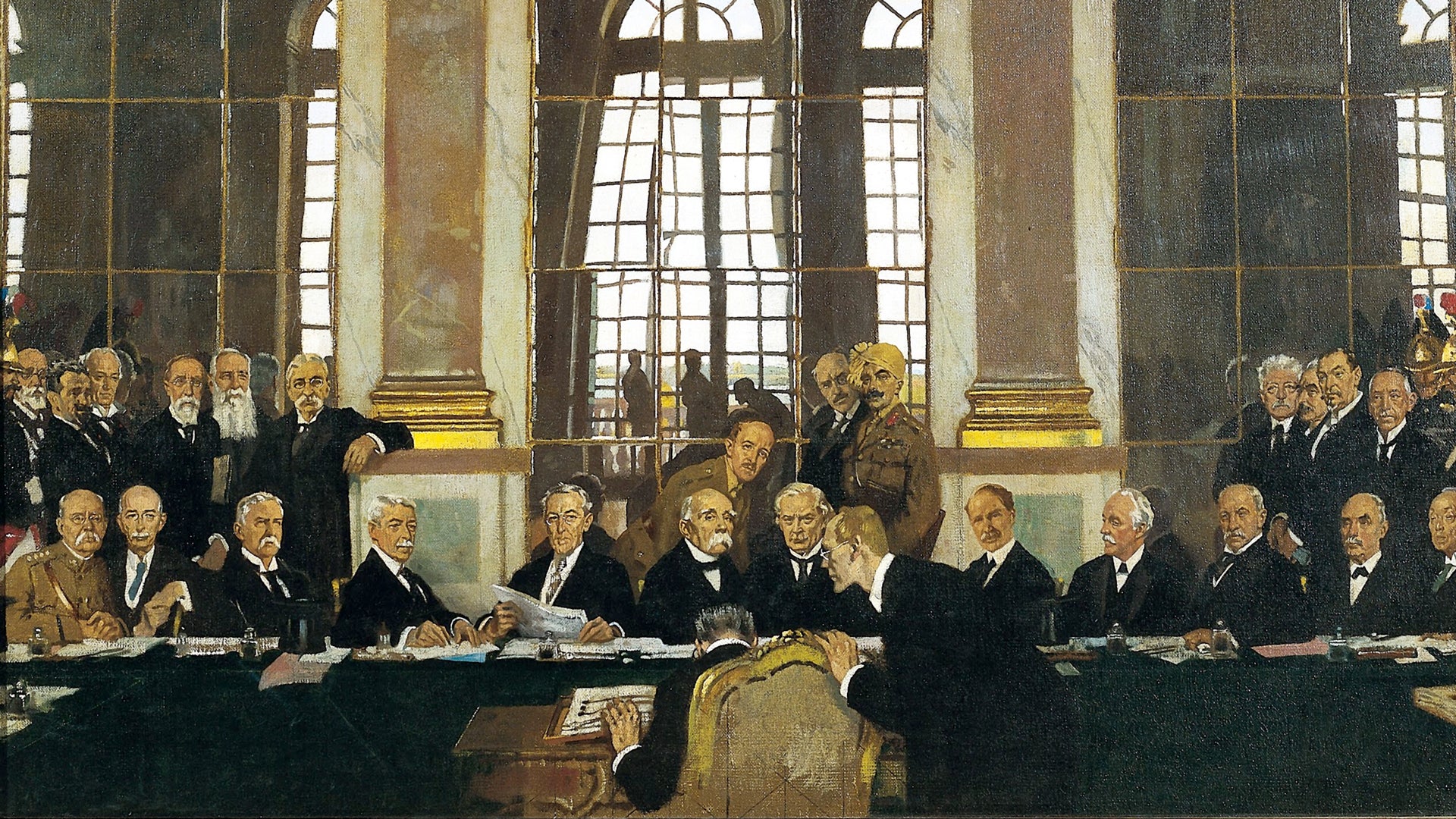
The Treaty of Versailles was signed by Germany and the Allied Nations in 1919, which formally ended WWI, one of the deadliest global conflicts in history (Crooks, n.d.). There were “good intentions” from the start since a treaty is where the parties came to an agreement, according to its etymology at least. It was inherently good from the drafting committee’s perspective. Although, the plan included various guilt clauses, such as the War Clause which forced Germany to take the blame for the war which included loss of territories, reduction in military forces, and general reparations (Crooks, n.d.). This angered the Germans and sowed the seeds for WW2 (World War 2). The committee drafting the treaty clearly lacked “understanding” of Germany’s perspective, which was their grave mistake demonstrating Camus’s point. As with WWI, WW2 was not simply a mistake, but rather a plan that took advantage of the initial mistake, which was the Treaty of Versailles. After the Treaty’s failure, Adolf Hilter used the unfairness of the treaty as leverage to gain political power in Germany. He would become the Chancellor of Germany (the powerful) and consolidate power and implement totalitarian rule in 1933, setting the stage for his plan to start WW2 (USHMM, n.d.). Technically, Hilter was not forced to invade Poland and start WW2, which demonstrates some intention in his actions. Thus, WW2 was planned and took advantage of the Treaty of Versailles. The effects of this bloodbath was essentially the most catastrophic war in history amounting to 35 - 60 million people dying, making it the highest wartime death toll in history (WW2 Museum, n.d). Furthermore, the cataclysmic impact of WW2 still reverberates through the annals of history: the Holocaust, Japanese Internment, and the Nanjing Massacre.
The Treaty of Versailles, discussed as a pivotal planned outcome with major downstream effects.
As an indirect consequence of WW2, the South African government wanted to strengthen their control so they heightened the racial segregation laws and institutionalized white minority rule. The architect of the Apartheid, Henrik Verwoerd, was a South African politician and had a large part in shaping the Apartheid policy in the late 1940s (SAHO, n.d.). Still following Camus’s logic, the “good intentions” here were to strengthen the nation, but racial segregation was horribly misunderstood as the best way to salvage the nation and thus Apartheid was a mistake. It is stated in the Universal Declaration of Human Rights that, “all are equal before the law and are entitled without any discrimination to equal protection of the law,” which was implemented by the UN the same year as Apartheid (United Nations, 1948). The South African lawmakers failed in “understanding” this principle as part of their government’s responsibility. Luckily, as with any form of oppression, people do revolt, and so arose the Anti-Apartheid movement. The Free Nelson Mandela campaign was a plan enacted through an international collaboration against Apartheid. Powerful organizations like the International Aid and Defence Fund backed the cause, and leading powers like the United Kingdom would create plans, like holding rallies and festivals to destabilize cultural legitimacy Apartheid. The global collective of cultural leaders were amending a grave mistake through various plans, which ultimately succeeded. Apartheid was eliminated in the early 1990s, and this eliminated the last trace of institutionalized segregation that plagued our world for more than a century. In the modern world, a precedent was set for much needed equality between all races.
It goes to show that a plan’s influence is universal, extending its reach to the social, cultural, and political realms. The mistakes discussed in this paper were a result of a plan, but not pure accidents. For example, arguably the biggest accident in the past century, the Deepwater Horizon Oil Spill in 2010, which afflicted millions of people, was not a mistake of the powerful but rather their workers. Many of those mistakes tend to play out in a similar fashion or their effects are not as widespread as the examples above. Plans and mistakes have a convoluted bond, but it remains true that the powerful use their influence to exploit mistakes and formulate plans off of them. To finish Camus’s thoughts, he further stated, “There can be no true goodness […], without the utmost clear-sightedness” (Stewart, 2011). Most of the powerful above intended to do what was good for their country, and having “clear-sightedness” or a vision is what gets the job done. From WWI to the present time is a cascading chain of plans falling in place one after the other. The paintbrush the powerful wield is a purposeful tool; with intent, one can paint a masterpiece that is called written history.
Final Thoughts
Whew, that was a long one! A few things I’d note for anyone looking to write an academic essay like this: after your hook and introduction, it’s a good idea to include a paragraph that outlines your argument — almost like an abstract. It helps the reader know where you’re headed before you take them there. It also helps to ground your reasoning in a philosophical framework, whether Eastern or Western — I drew on Albert Camus here, but you can really choose anyone whose ideas fit your argument. Overall, entering this competition was a great way to push my writing to a college level, and I’d genuinely encourage anyone to give it a shot!
]]>The Zeta Function: A Gentle Introduction2023-08-16T00:00:00+00:002023-08-16T00:00:00+00:00/zeta/functions/2023/08/16/primes-zeta-functionsIntroduction
I recently attended PROMYS as a second-year student, and I wanted to capture some of the cool math I learned there before it slipped away. The primary course I took was Prime and Zeta Functions, where we covered zeta functions, Dirichlet functions, Gauss sums, and more. It was all genuinely fascinating! In an attempt to not forget any of it, I’ll give a beginner’s introduction to the Riemann Zeta Function — starting from the very beginning of the course.
Square Free Integers
Question: How many square free integers are there less than 100? 1000? 5000?
We define a square free integer as an integer that doesn’t contain any squares in it’s prime factorization. For example, 10 is a square free integer because it’s $2 \cdot 5$. Although, 12 isn’t a square free integer because it’s $2^2 \cdot 3$.
Is there a way we can sift out all the numbers that have squares in their prime factorizations? There is an intuitive way to think about this. There are approximately 3/4 integers that don’t have factors of 4. Similarly, approximately 8/9 integers don’t have factors of 9. 24/25 integers don’t have factors of 25. Notice how we skipped 16 because we already counted the factors of 4. Thus, we are only looking at prime squares in order to avoid overcounting. So we have a probablitic number of square free numbers.
For square free integers less than 100, there are approximately…
\(\frac{3}{4} \cdot \frac{8}{9} \cdot \frac{24}{25} \cdot \frac{48}{49} \cdot 100 = 62.69387...\)
This is an approximation for the amount of square free integers. We can write each term as $1 - \frac{1}{p^2}$ where it almost looks like a geometric series. Although, how can we know that $N \cdot \prod_{p} \left(1 - \frac{1}{p^2}\right)$ is actually a number? We can’t. Which is why it’s an approximation. Notice that if we expand $\prod_{p} \left(1 - \frac{1}{p^2}\right)$, we get…
This looks like to be $\sum_{1}^{\infty} \frac{1}{n^2}$ except there are some pesky negative and positive terms. Those just turn out to be evaluted by the mobius function $\mu(n)$. So we get, the above sequence as $\sum_{1}^{\infty} \frac{\mu(n)}{n^2}$.
How can we get rid of the negative signs? We can make it a geometric series. This would require writing… $\frac{1}{1 - \frac{1}{p^2}}$ over all p prime. This is also known as an Euler Product.
where $s = 2$ when we are looking for square free integers. Expanding the Euler product, we get $(\frac{1}{1 - \frac{1}{2^2}})(\frac{1}{1 - \frac{1}{3^2}})(\frac{1}{1 - \frac{1}{5^2}})…$ for s = 2, and p prime where all the terms are in the from $\frac{a}{1-r}$ which is the formula for the sum of an infinite geometric series. That’s equivalent to…
Notice, that if we have $\zeta(2)$, then we must have $\zeta(3)$, $\zeta(4)$, … and so on. An interesting question to ask is whether these functions converge for certain s? We know that $\zeta(1)$ doesn’t converge because this is the harmonic series. If you have taken AP Calculus BC, the following fact will be very familiar.
Claim:
\[\sum_{n = 1}^{\infty} \frac{1}{n^s} \text{ converges if } s > 1\]
The above fact can be proved in a variety of ways. Although one way is a favorite of mine because of how intuitive it is.
First let’s write out all the terms….
Notice that $\frac{1}{2^s} + \frac{1}{3^s}$ is bounded by $2 \cdot \frac{1}{2^s}$. Similiarly $\frac{1}{4^s} + \frac{1}{5^s} + \frac{1}{6^s} + \frac{1}{7^s}$ is bounded by $4 \cdot \frac{1}{4^s}$ and so on…
In this way we can say that $\sum_{n = 1}^{\infty} \frac{1}{n^s}$ is bounded by $2 \cdot \frac{1}{2^s} + 4 \cdot \frac{1}{4^s} + 8 \cdot \frac{1}{8^s} + … = \frac{1}{2^{s-1}} + \frac{1}{4^{s-1}} + \frac{1}{8^{s-1}} + …$ which is a geometric series and has a finite value because the geometric ratio is $\frac{1}{2^{s-1}}$ is less than 1 because $s > 1$. Thus, $\sum_{n = 1}^{\infty} \frac{1}{n^s}$ is bounded.
Knowing this fact, we can change the question to find what values the $\zeta$ functions converge to. To find what value $\zeta(2)$ converges to, we can look at the $sin(x)$ and find two polynomial expansions of it and equate the coefficents. $sin(x)$ is a good function to use because it’s linear approximation is really clean, $sin(x) \approx x$.
Sin(x) and Taylor Series
It’s a known fact that the Taylor expansion of $sin(x)$ is $\sum_{1}^{\infty} (-1)^k \frac{x^{2k+1}}{(2k+1)!}$ where the coefficent of $x^2$ is $\frac{-1}{6}$. We divide the whole series by x, because $\lim_{x \to \infty} \frac{sinx}{x} = 1.$
We also know that we can write a polynomial in terms of it’s roots, so can we do the same for sin(x)? The roots of sin(x) are $0, \pm \pi, \pm 2\pi$, … In terms of a polynomial this is…
This is a difference of squares, but we are aiming to find the value of the zeta function. So the coefficent of $x^2$ in the above polynomial is just $\frac{-1}{\pi^2} \cdot \zeta(2)$ which means that $\frac{-1}{6} = \frac{-1}{\pi^2} \cdot \zeta(2)$. or
$\zeta(2) = \frac{\pi^2}{6}$.
We could apply this same method to find $\zeta(4)$ because we can just square both polynomials for $sin(x)$ and equate the coeffcients. Even for $\zeta(3)$ we can just square the $sin(x)$ expression and multiply an additional $sin(x)$. The only problem with this method is that as you get larger $s$, it becomes harder to use the distributive law on the polynomials.
So what we solved above is called the Basel problem where we find the value where the zeta function for $s = 2$ converges. The Reimann Zeta Function forms the basis of the Reimann Hypothesis! The Hypothesis is about finding the zeros of the zeta function and it’s one of the most fundmental unsolved problems in mathematics (because if proven or disproven it reveals some results about the distribution of primes).
Final Thoughts
The zeta function is one of those topics that just keeps giving. I considered writing about Gauss sums or Dirichlet functions too, but the most interesting results from those rely heavily on proof machinery with very little computation to show — harder to make accessible in an article. What’s exciting is that the zeta function eventually connects with Dirichlet functions to prove that there are infinitely many primes of the form a mod m where gcd(a, m) = 1. Definitely worth looking into — the Dirichlet function is really cool! And keep an eye out for my article on the PROMYS experience itself.
]]>Christiaan Huygens and the Birth of the Pendulum Clock2023-06-09T00:00:00+00:002023-06-09T00:00:00+00:00/biography/2023/06/09/huygensIntroduction
Christiaan Huygens was a remarkably gifted Dutch physicist and astronomer, most known for his work on centrifugal force (yes, that concept you may have dreaded in AP Physics), the wave theory of light, and — dun dun dun — the pendulum clock! So the next time you find yourself procrastinating and glancing at the clock, spare a thought for Huygens. Seriously! Clocks before his were wildly inaccurate, losing as much as an hour a day. Now isn’t that something?
Huygen’s Early Life
Huygens was born into a wealthy family on April 14, 1629, and was immediately immersed in rigorous science and mathematics through private tutors. His father was a prominent diplomat and advisor to the House of Orange — the royal family of the Netherlands — and through those connections, young Huygens got to meet and converse with some of the greatest mathematical minds of his time. Among his father’s circle of friends, which included figures like Galileo and Marin Mersenne, Huygens met René Descartes, most famous for bridging geometry and algebra. It’s no wonder he turned out to be so gifted.
Huygen’s Pendulum Clock
For some context: clocks before Huygens’ pendulum clock lost around 15 minutes a day. His new design brought that down to just 15 seconds. So how did he come up with such an ingenious idea? He was a genius, certainly, but he was also building on Galileo’s findings. Galileo had been experimenting with pendulums and discovered a property that made them excellent timekeepers: isochronism, the principle that a pendulum’s period depends only on its length. We know this from the formula T = 2π√(l/g), where l is the string length and g = 9.8 m/s². There is one important restriction though — the rod can’t be too long, or the amplitude becomes too large, causing the pendulum to leave its cycloid path and lose its isochronism.
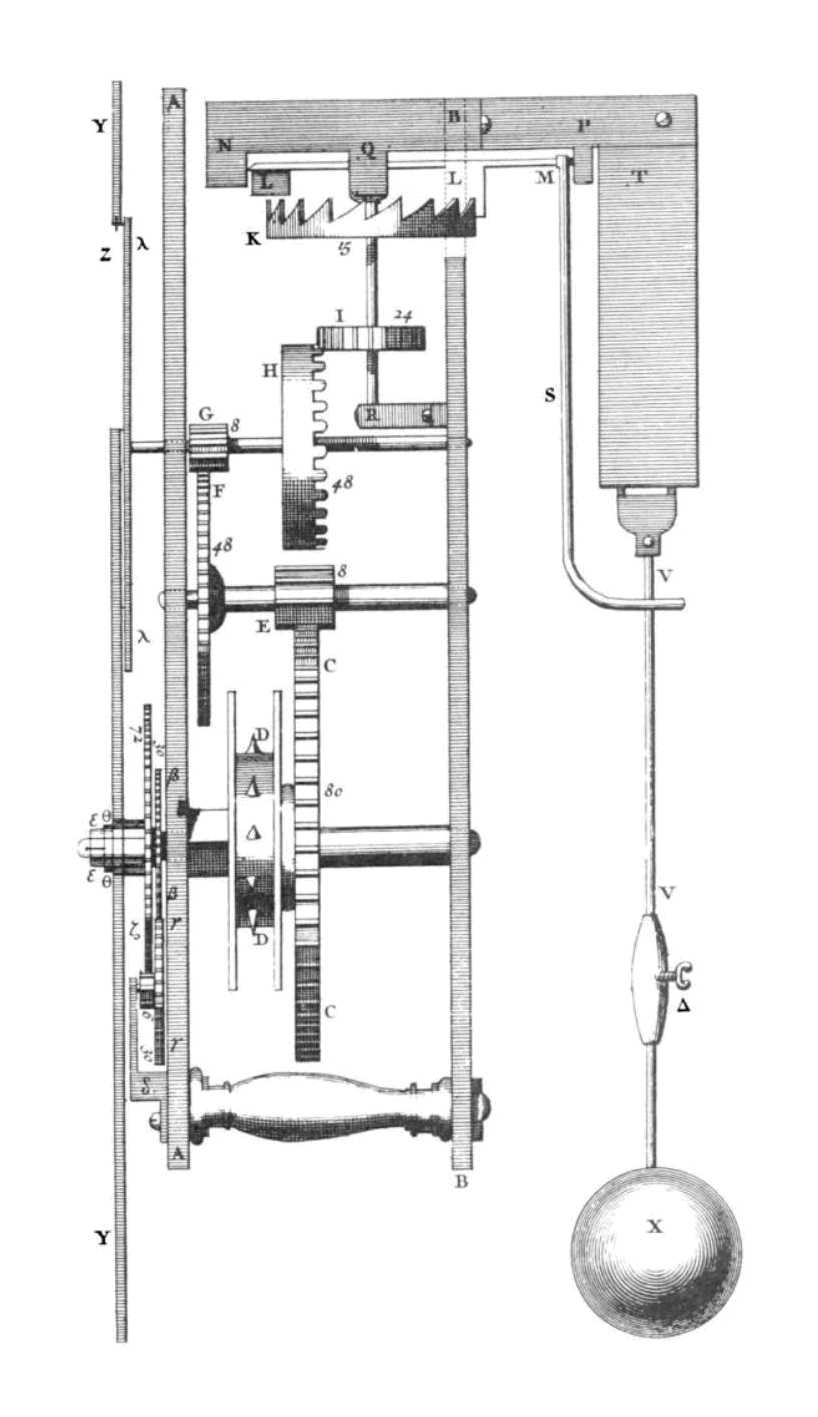
The drawing above shows what Huygens’ pendulums actually looked like — quite different from the simple string-and-bob you might be picturing!
Other Scientific Discoveries
Beyond being the father of the pendulum clock, Huygens is also the father of Titan. Let me explain. Titan is Saturn’s largest moon, and Huygens played a central role in its discovery. About five to ten years before his pendulum breakthrough, he had been experimenting with telescopes. He derived the law of refraction to calculate the focal distance of lenses, which led him to design and release his own line of telescopes — the Gucci of telescopes, if you will. In 1655, using one of these instruments, he identified Titan for the first time.
Fast forward to 1689: Huygens traveled to England to meet the great Isaac Newton. The two debated the famous wave vs. particle theory of light. Newton firmly believed light traveled in particles; Huygens argued it traveled in waves. Most people sided with Newton, largely due to his towering reputation. That said, Huygens’ wave theory was eventually recognized and incorporated into our modern understanding of light — it just took a little over a century for that to happen.
Huygens’ legacy lives on through both his theory of light and the moon he discovered. In fact, NASA named its 2005 Titan probe the Huygens mission in his honor. But his story doesn’t end there.
Huygen’s Synchronzing Pendulums
After patenting his pendulum clock, Huygens fell seriously ill — a sickness that would torment him throughout his later years. But his scientific curiosity never wavered. In 1665, at 36 years old, he was lying in bed during a bout of illness, idly watching two of his pendulum clocks hanging on the wall. After a while, he noticed something strange: they were moving in sync. He experimented further and found that no matter how the pendulums were started, within about thirty minutes they would always synchronize — same period, same amplitude, just swinging in opposite directions.
For context, these were large pendulums with rod lengths just over a meter. Not everyone was impressed, though. When Huygens presented his findings to the Royal Society, they were underwhelmed, attributing the phenomenon to measurement inaccuracies and dismissing it as coincidence.
The observation raised a fascinating set of questions: how do the pendulums synchronize? What factors affect the rate? Some of these have since been answered — but 300 years later, there’s still plenty of research left to be done.
Further Research
I was so fascinated by Huygens’ ideas that I decided to do some physics research of my own around this topic. You can find my research write-up on my website — it’s currently under peer review. I’m also planning to post more documents from my math research there, so stay tuned!
Final Thoughts
Overall, Huygens was a pretty cool dude. Although, usually with the greatest scientific contemporaries, I can find some interesting fun facts about their hobbies and such, but I couldn’t find that with Huygens. Maybe he was very invested with his scientific discoveries (and the fact that he died quite early).
]]>Getting Started with LaTeX: A Beginner’s Guide2023-04-09T00:00:00+00:002023-04-09T00:00:00+00:00/latex/2023/04/09/23-latexIntroduction
I’ve been using LaTeX since around 7th grade, and it’s helped me tremendously. As a math enthusiast, there was no way I wasn’t going to learn this language — it makes mathematical formulas in a document look seamless. And beyond the math, even just formatting a document feels cleaner in LaTeX. Editing the preamble gives you a level of control that’s honestly superior to anything I’ve encountered in Google Docs or Word.
Installation of LateX on MacOS
It’s pretty simple to install LaTeX for MacOS. All you need to do is to download MacTex (https://www.tug.org/mactex/) and let that download.
MacTex does automatically download a TeX Editor, but I personally think VS Code is easier to work with. So in conjunction with downloading MacTex, you can just download VS Code. All you need to do is to download the LaTeX Workshop extenion on VS Code and you can download LaTeX files.
It’s helpful because if you are running a website and you have MathJax running on it, you can have LaTeX on it as well.
For other installations, visit the official webiste: LaTeX-Project
How to format a document
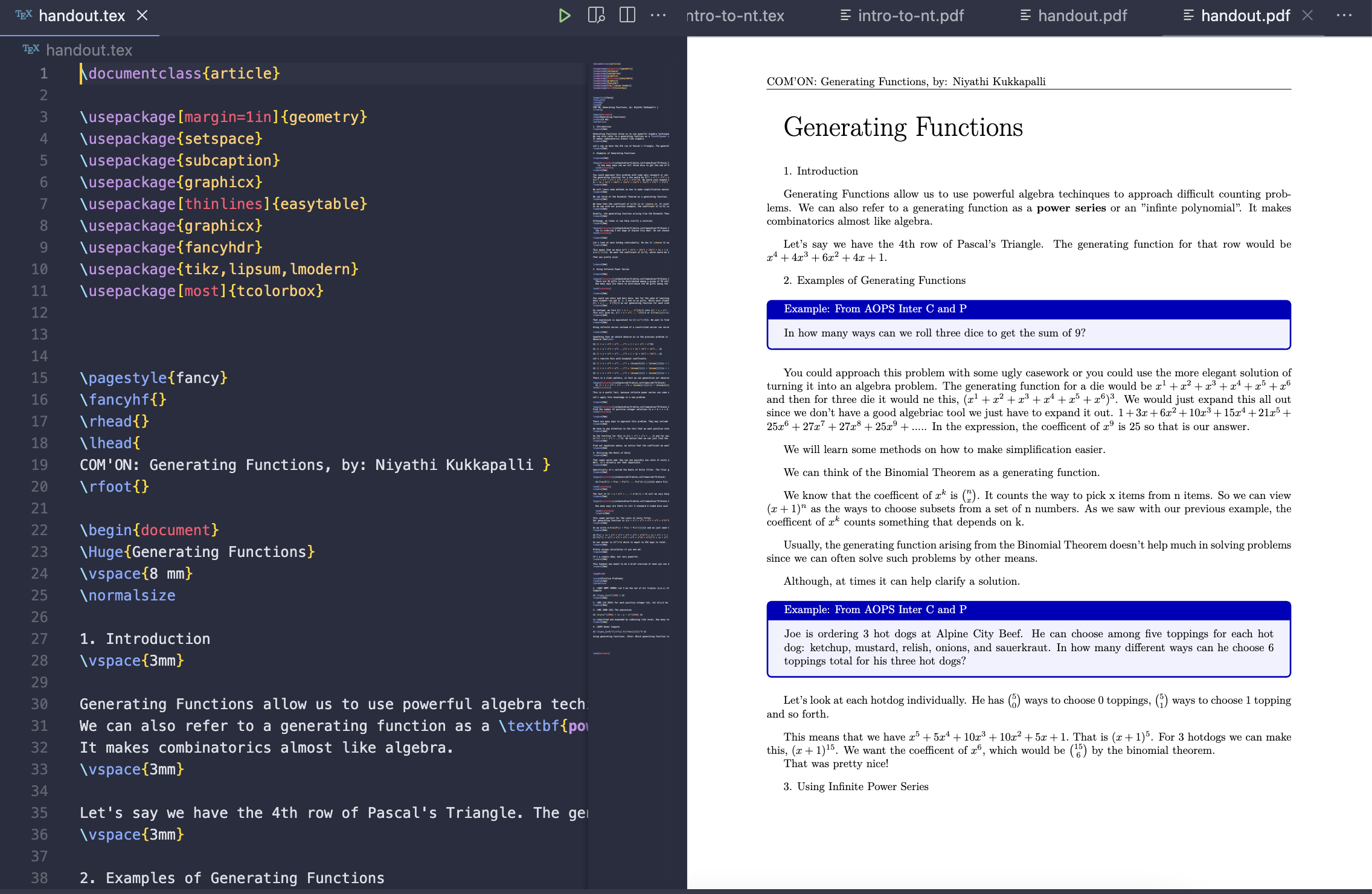
I’ve been involved with math competitions, like USAMTS, which require you to send in worked out solutions and LateX is a great way to format them. Usually if you work in Overleaf they give you the basic commands like $\texttt{\section{}}$ or all the packages at the top. An example of one of my handouts is below…
On the left is the code space, you can see things like a header (\lhead or \rhead) for either a left or right header. There is also some extra stuff like bolding words is $\texttt{\textbf{}}$ and there are font sizes like $\texttt{\Huge{}}$. A useful trick is also putting $\texttt{\vspace{3mm}}$ between paragraphs for that extra space beacuse LaTeX won’t automatically space out your document. On the right is what the a LaTeX document would look like.
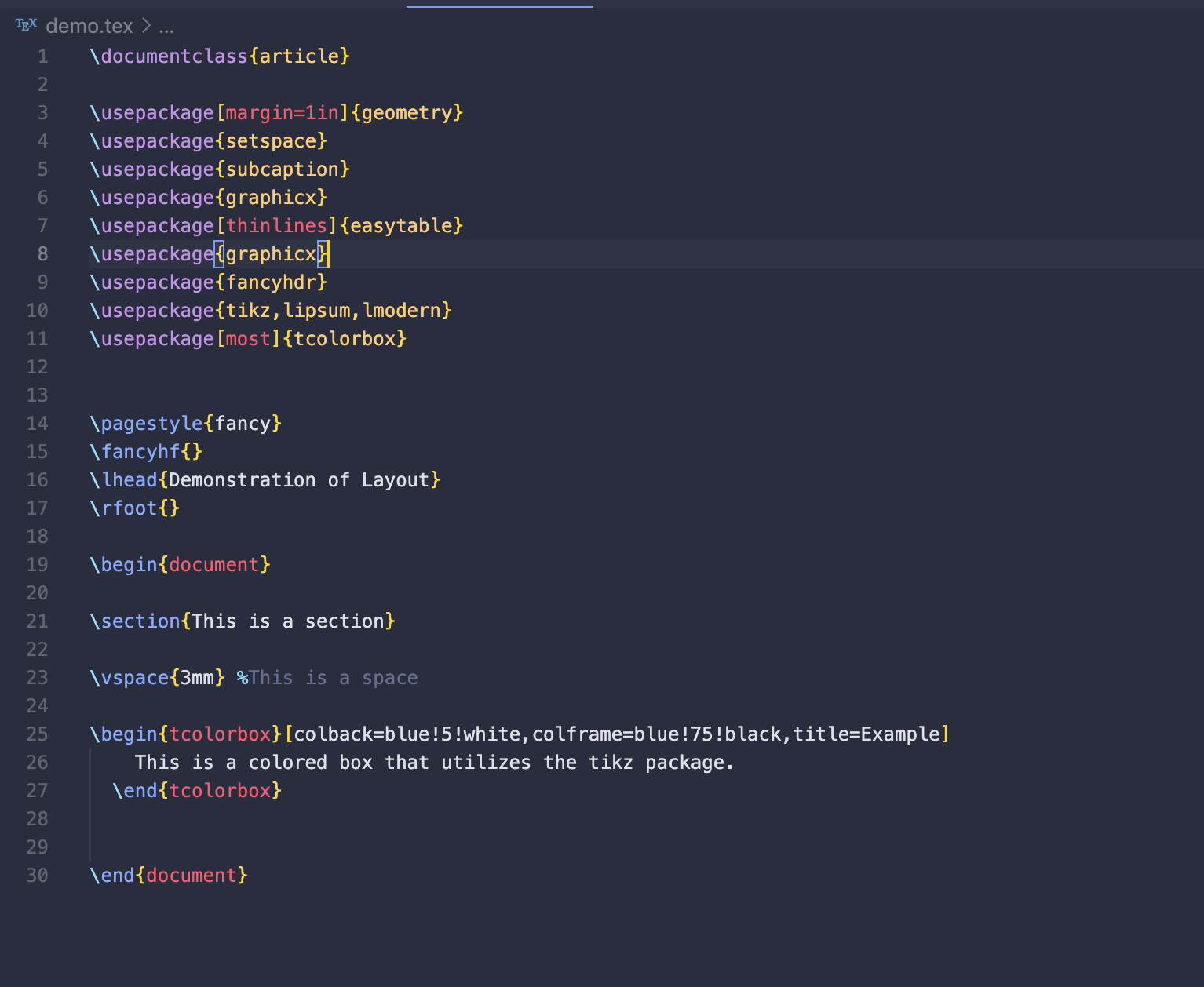
Below is the general document setup I use, with a color box embedded as an example. The setup is really simple, it’s just a matter of packages.
Most documents have a bunch of packages at the top, and there are only a couple basic ones that I find really useful. You input a package that you need into the top of your document by enclosing it in $\texttt{\usepackage{}}$.
TiKZ package: is typically used for graphics, like making colorful boxes. You can see an example of those on my Generating Functions Handout
Article package: is the most basic class, used for making articles
Biblatex package: is useful for citations in scientific articles, and you add citations by putting your citation in $\texttt{\addbibresource{}}$
Geometry package: controls the size of the document, it’s margins, and other page setup functions
Graphicx pacakge: allows you to include images into your document
Hyperref pacakge: allows you to embed hyperlinks into your document.
Most of the packages I listed above are general use packages, meaning you will probably need them no matter the type of document. Keep in mind that there are over 4000 packages, so it’s best as you discover the packages as you find commands that require them.
Basic commands
Whenever you type something in LateX, you have to surround it by dollar signs for it to render. You can use double dollar signs on each side for the rendering to be centered. Below is a table of some of the more useful commands…
Symbol
Code
$\frac{a}{b}$
$\texttt{\frac{a}{b}}$
$\binom{a}{b}$
$\texttt{\binom{a}{b}}$
$\sqrt{a}$
$\texttt{\sqrt{a}}$
$a_{2022}$
$\texttt{a_{2023}}$
$\Sigma_{i=1}^k x_i$
$\texttt{\Sigma_{i=1}^k x_i }$
$\int_a^b f(x)dx$
$\texttt{\int_a^b f(x)}$
$\lim_{x \to a} f(x) = n$
$\texttt{ \lim_{x \to a} f(x)} = n$
These are the most basic commands, but I encourage you to look up the more complicated ones on Overleaf (https://www.overleaf.com/learn).
Other Fun Sites
Sometimes you want a smiley face or a heart in your document, but you don’t know how to render one? Well, DeTeXify can help! Basically you draw the symbol you want and it’ll spit out the command, package, and mode. I made all the shapes of the McDonald’s chicken nuggets on this site, (Yes they are supposed to be shapes: a bell, ball, boot, and tie) This is defintely a site to be bookmarked.
For you nerds who end up really liking LaTeX, I would try playing TeXnique. It’s a game where you are given a theorem and you have to type it out in LaTeX in under a minute. A good pastime if I must say. I’ve learned many obscure math theorems from this site (Ex. Coarea Formula) - great for Trivia buffs!
Overleaf also has a lot of fun templates that you can copy and paste into your TeX Editor. I actually ended up using a couple of the Resume ones to contact professors and for scholarships.
Final Thoughts
LaTeX isn’t all that complicated to learn — it just takes practice to get fluent. Typing up all my math solutions in LaTeX during my AoPS classes really cemented my skills. It’s a genuinely useful thing to know, it looks great on a resume, and once it clicks, you won’t want to go back. Have fun with it!
]]>My First Research Experience: Dynamical Physics2023-04-01T00:00:00+00:002023-04-01T00:00:00+00:00/research/2023/04/01/23-researchIntroduction
Independent research is actually more common than you’d think — it’s how most prolific ISEF qualifiers start their journey! In general, having research experience on your resume is a great way to build skills across computing, engineering, writing, and more. Honestly, I was completely overwhelmed when I first started looking for a topic. Every website I checked either featured the classic exploding volcano or something so complex it exceeded any reasonable scope for a high schooler. There was never an in between! I’ll be referencing my own research throughout this article, so feel free to check out my abstract on my research page.
Finding a Topic
The hardest step is always finding a good topic — data collection is a piece of cake compared to it. I can already picture the frustrated faces: “But how do I actually find one?!” If you’re in high school, you’ll probably want something with a reasonable level of complexity, which I’ll get into. If you’re in middle school, I’d suggest starting with Science Buddies (https://www.sciencebuddies.org) — it’s a great place to branch off from.
I found my topic by browsing YouTube, particularly Veritasium’s channel (https://www.youtube.com/@veritasium), which is full of fascinating physics ideas. Another approach is to cold-email local professors and ask if they’d be willing to supervise a project or suggest ideas. That route doesn’t always pan out, so doing your own literature reviews and watching videos is usually more reliable.
The best strategy is to take a well-known problem and give it a unique twist that hasn’t been explored before. My project dealt with synchronizing pendulums — a topic studied by top institutions like Harvard and UCLA. After reviewing the existing research, I noticed that nobody had specifically looked at how the physical properties of the pendulum affected synchronization. So I did just that.
Reading it plainly, the topic might not sound groundbreaking — changing string lengths to observe how synchronization in coupled pendulums changes? But I was surprised to learn that synchronization is actually used in end-to-end encrypted systems as an encryption key. The lesson: find a topic you’re genuinely passionate about, then discover the applications later.
Now that a topic is secured, what’s next?
Collecting the Data
This is the most crucial part of the experiment. I needed to collect the synchronization times for each string length that I set the coupled pendulums to have. For my project I created physical pendulums but I also had a computer model of my coupled pendulums. This was to corroborate the data from my man made pendulums because they may not be super accurate. Luckily, to my favor, the data from both models matched without any changes from my part.
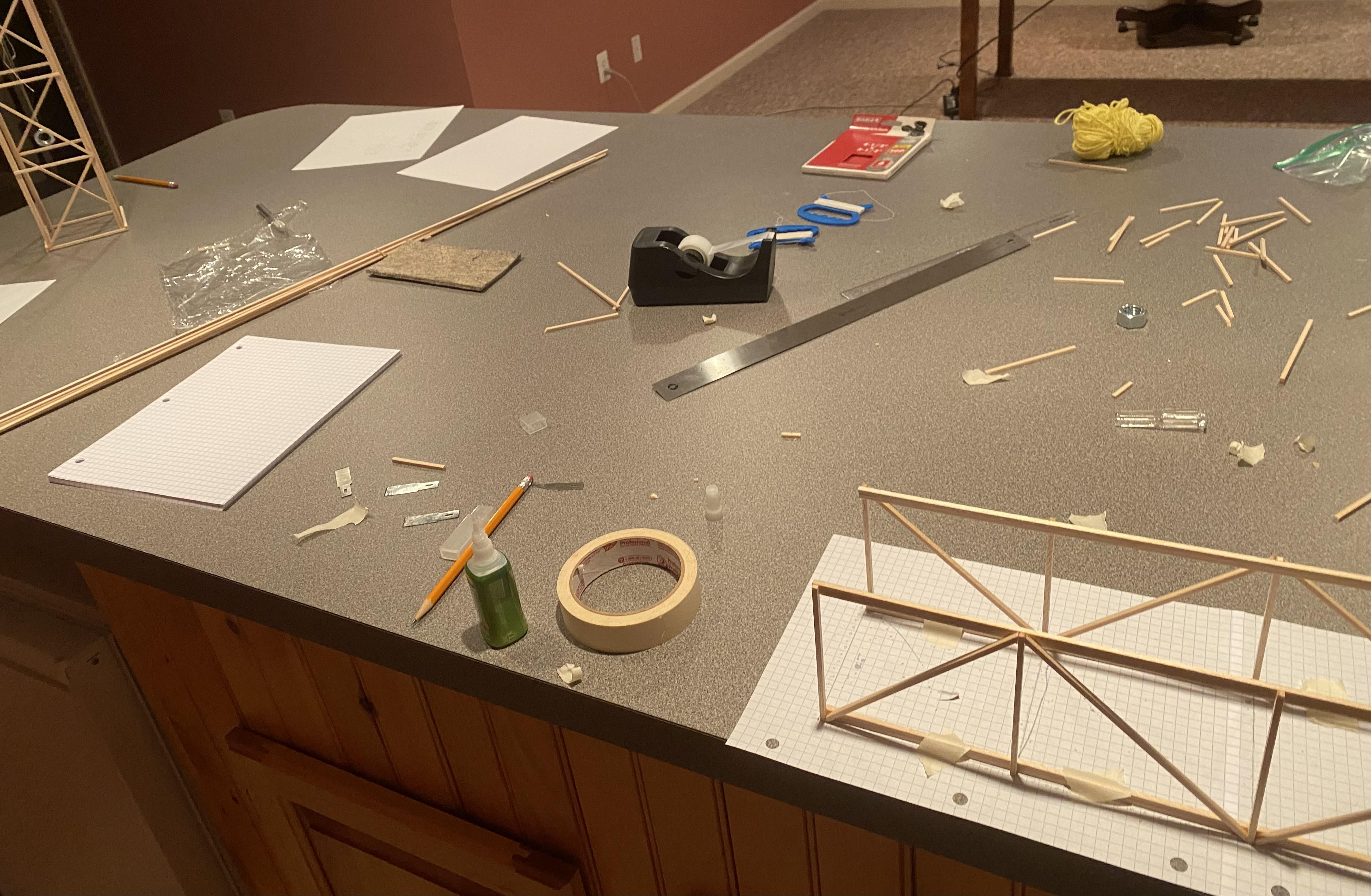
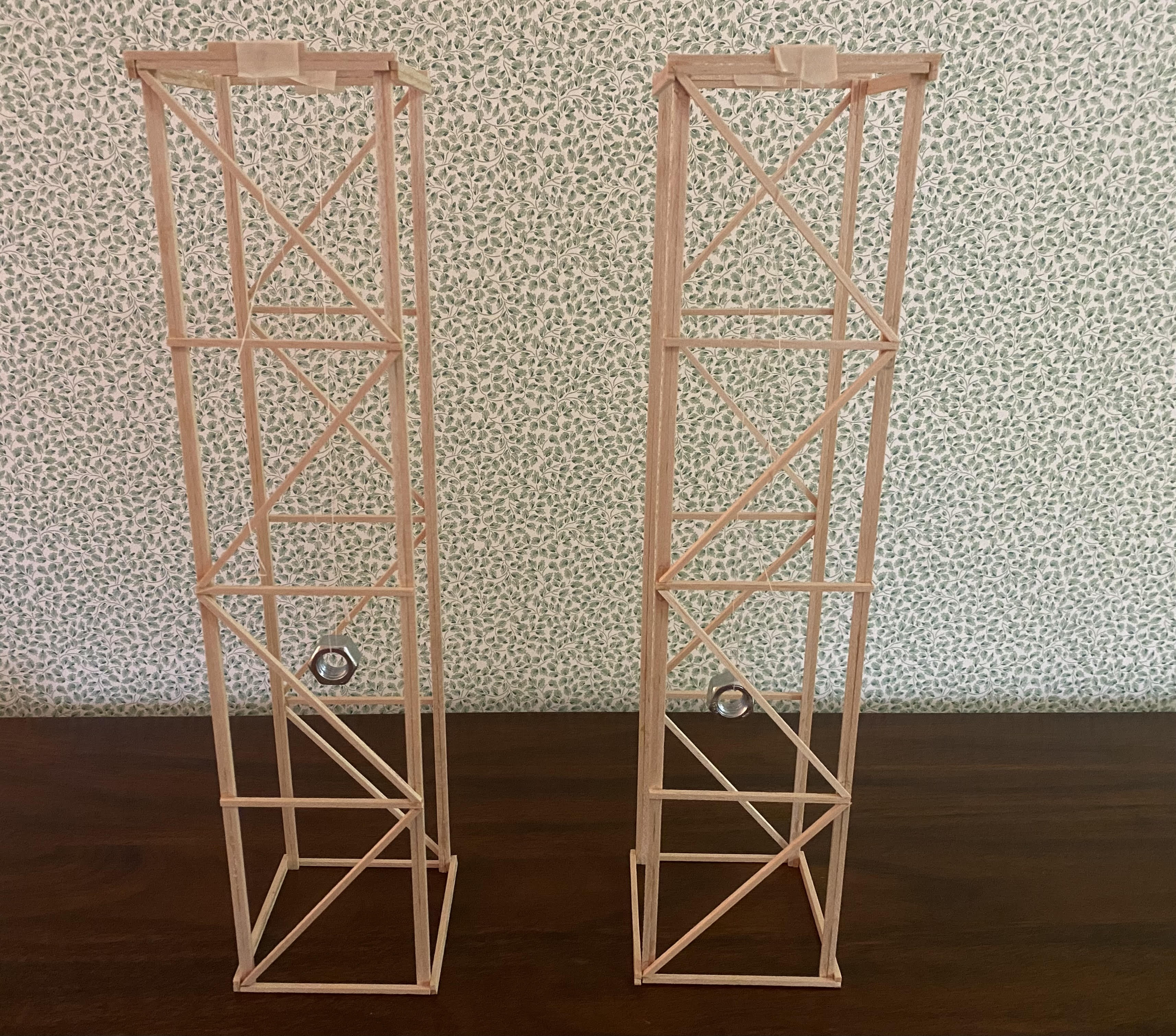
Creating the pendulums was quite hard and I had to recruit the help of my brother to help complete them. Let me just say, there were a lot of sticks and hammers all over my workspace (shown below).
The pendulums that I created are also shown below, though they show hex nuts on them instead of bobs. I found that the hex nuts carried a lot of air resistence and kept twisting in the air; I changed it to a bob later because of the hassle it caused.
Most data collection is quite menial. Whether you are running a computer program or simulations, it’s never fun. But it has to be accurate. Sometimes, my pendulums would be off center on the platform or the platform would roll off the cans so I would have to redo those cases. Most of my data collecting was me sitting in front of my apparatus with my lab notebook: of course, I had a pencil in one hand and my stop watch in the other.
The most important thing is to keep a neat lab notebook because it documents your whole research journey. I made an effort to include my analysis of data in there and not just my quantative numbers. Judges at science fairs also really appreciate a neat notebook.
Writing a Report
Most research papers make use of LaTeX, a typesetting language that’s excellent for papers with a lot of math. I have a LaTeX tutorial on my blog if you want to get started. Even if your project isn’t math-heavy, LaTeX makes your paper look clean and professional. You can also browse papers on arXiv to see how it’s used in practice.
When analyzing your data, make sure you include solid statistical analysis. For me, that meant adding regression lines and error bars to my graphs.
One thing I kept slipping up on while writing: using “I” or “we” in the paper. Research papers should be written in passive voice throughout — a surprisingly hard habit to form when you’ve spent a year in AP Language and Composition.
Presenting at Science Fair
Presenting at a science fair is somehow ten times more nerve-wracking than any other presentation I’ve given. Maybe it’s the judges standing just a few feet away, or the clipboards and quiet, evaluating eyes. Whatever it is, it’s real.
I’ve seen genuinely impressive, ISEF-worthy projects get passed over because the presenter left the judges more confused than when they walked up. Science is fundamentally about communicating ideas clearly, and that’s exactly what judges are evaluating. Fancy vocabulary means nothing if no one understands you. In fact, clarity was one of the most consistently positive comments on my feedback rubric — and getting that rubric back is itself a great reason to participate in science fairs.
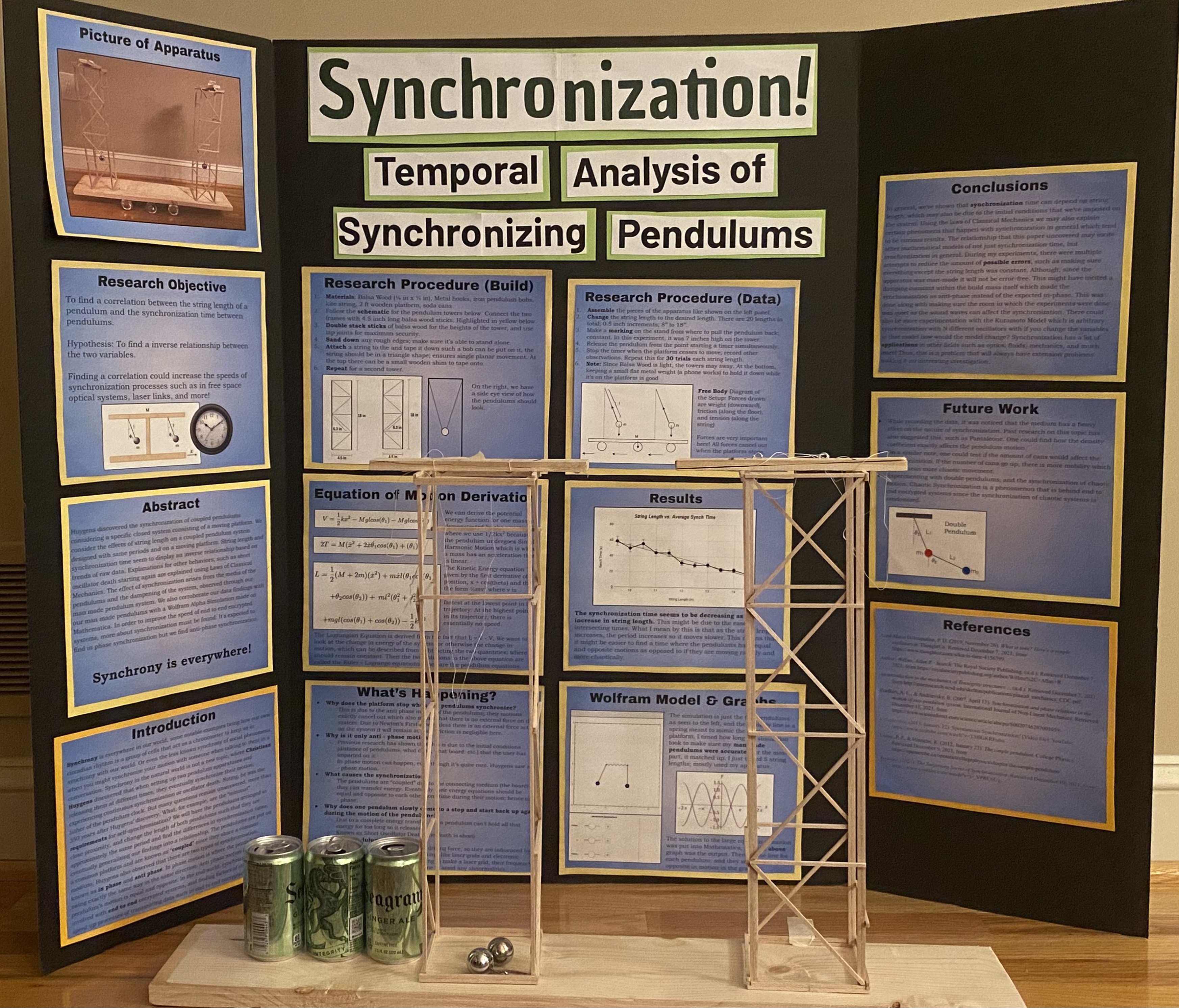
For my setup, I brought one of my physical pendulums and played a video of them synchronizing. It did a lot of the talking for me and helped me stay concise. My poster is pictured above — I used it for my school, county, and tri-state science fairs.
There’s no single right way to design a poster since the science matters far more than the aesthetics. A lot of people print their entire poster as one large sheet at Staples, and honestly it does look impressive. I kept it simple and printed individual slides from a Google Slides presentation. Both work fine.
Final Thoughts
The takeaway is this: you don’t need a PhD-level project to do well at a science fair or impress people with your research. As long as your data is solid and your presentation is clear, you’ll go far. And along the way, you’ll learn so much more than you ever would working on something you don’t actually care about.
]]>A USAMTS Year 34 Round 3 & Overall Review2023-02-20T00:00:00+00:002023-02-20T00:00:00+00:00/usamts/2023/02/20/usamts3What’s USAMTS?
USAMTS is a free, high school oriented, proof based contest that is funded by NSA. The contest consists of three rounds, each with 5 problems and worth 5 points. The contest is fully remote and is a month long since the problems are hard enough to not get immediately. The contest is a great way to think about problems constantly and sharpen your math skills.
Problem 1
So this puzzle was a bit different from the others because there was no givens in the sense that there was no X’s or Y’s given to us.
Although we were given the hearts and stars which was helpful. There are some essential things to note here which would be
that the row of stars on the top needed just one X in front of it since each star is already in a row with one other X and Y.
It’s the same case for the rightmost column with stars. The first “given” that I found was that below the star in the second to bottommost row, that needs a Y below it.
From there you know that the Y in the second to right column needs to be in the bottom 3 squares.
From there it’s a whole chain of “givens” that provide you the answer.
Problem 2
This problem was pretty straightforward, at first I was about to go with the wrong answer that there is no function because I was simply
thinking that only polynomials could only work although there are many functions such as piecewise functions. I chose a function with mod 5 because I though that could cycle in 4 times so luckily that worked.
I spent a lot of fruitless time researching cyclic functional equations and basically trying to manipulate $\frac{1-x}{1+x}$ since that
was a solution, but it just didn’t output integer solutions. So sometimes just thinking about the problems for a little bit of time can get you the answer.
Problem 4
This was a problem that I spent a lot of time on but I still got it wrong. The answer had something to do with ellipses and noticing that O and H could be
the foci of the ellipse. I still don’t know how I misunderstood it, but I thought that the area would be the whole circle because when I made a system of equations and graphed the soutions,
it seems that it filled the entire area. I am still unsure of what I misunderstood.
Anyway I created a system of equations with the centroid of the triangle and the equation of a circle with a radius 10. I got 5 equations with 6 variables and I put it into Wolfram Alpha
and got many solutions that could work so I’m assuming there was just some disconnect with the problem.
Problem 5
This was quite the tricky problem, and I spent a lot of time on this one too. The strategy that I took was finding configurations for smaller values instead of 2022 outright.
For $n = 2$, we notice that a octogon works out. Although, finding $n = 3$ was really hard for some reason. I tried just drawing an octagon and drawing three dots on each side and putting
dots on the interior of the octogon. Although I saw that you had to have the points all inside some “enclosed” region. For example, when I drew an octogon the other points that I draw
should be in the inside and not on the outside otherwise one of the lines with a slope of -1 or 1 wouldn’t work. Like how a square’s corners wouldn’t work if we wanted to cover 2 points.
When I looked at the solution it was one of those where I don’t think I would’ve been able to get it but it didn’t feel that unfamiliar either.
Final Thoughts
This round was significantly harder than the other two to me at least because the proofs felt more involved especially for 3, 4, and 5.
While the problems that I got right were probably more minimal compared to the ones that I got in the other rounds, the problems were hard and nice to think about.
Overall, USAMTS is a good contest to solidfy your proof skills, because usually if you do AMC or AIME you have enough knowledge to do some of the proofs.
The puzzle also gives everyone an easy 5 points since you just need to be persistent.
Good news is that I’m on the leaderboard for rounds 1 and 2 of the contest so far, so let’s hope that my score isn’t totally demolished by this round.
Now that USAMTS is done, I guess it’s time to work on the other upcoming olympiads. Maybe I’ll make a post after the f=ma when discussion period is allowed.
]]>A USAMTS Year 34 Round 2 Review2022-12-06T00:00:00+00:002022-12-06T00:00:00+00:00/usamts/2022/12/06/usamts2What’s USAMTS?
USAMTS is a free, high school oriented, proof based contest that is funded by NSA. The contest consists of three rounds, each with 5 problems and worth 5 points. The contest is fully remote and is a month long since the problems are hard enough to not get immediately. The contest is a great way to think about problems constantly and sharpen your math skills.
Problem 1
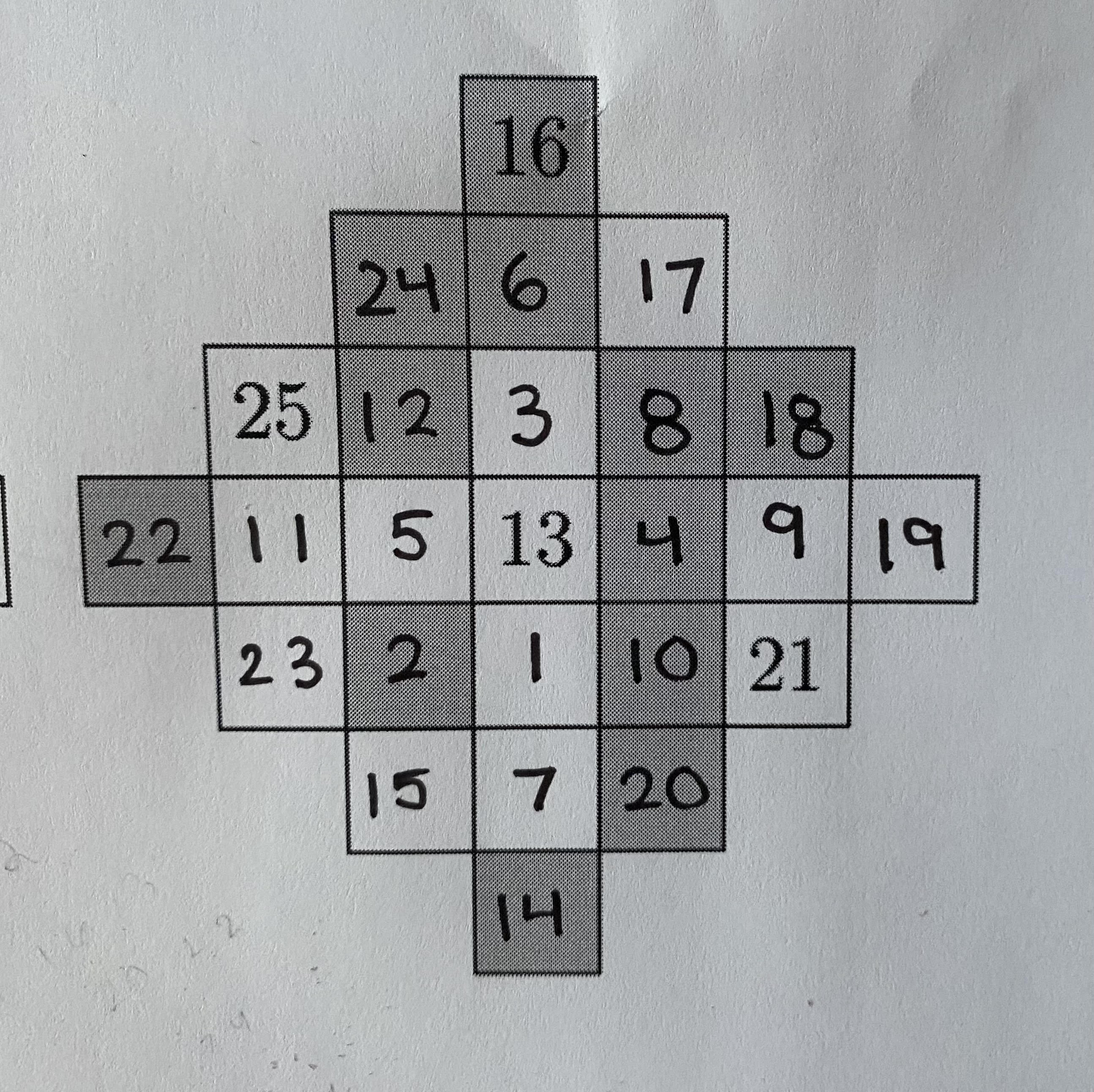
I don’t know if it’s just me, but this puzzle felt harder than previous years. I spent a significant amount of time on it, and for a while my only foothold was knowing that 5, 3, and 1 had to go into the center white squares. Honestly, it was hard to see how to approach this without just writing a program.
My starting strategy was to list all possible values for each square. This worked well for squares that had given neighbors, but broke down for “lone” squares — ones with no given values nearby — where you basically had to leave them open and come back later.Looking at the diagram: the square marked 4 could only be 2, 4, or 6; the square marked 9 could only be 7 or 9 given the 21 below it. I built a giant table of possibilities for each square this way. After enough tinkering, I noticed that certain odd numbers — 7, 9, and 11 — paired up with 19, 15, and 23 in some order. That pairing became the basis of my casework, and once those three pairs were placed, the rest of the numbers fell into place.
Problem 2
This problem was actually really easy, although I read the problem wrong. Just applying the basic principles of expected value gets you the answer. The only values we have are 0, 1, and 2 since Grogg flips a coin only once a day. I started doing the case where he flipped it infinite times a day.
Let’s call probablity where he fufills the second condition of getting a cookie, T.
The expected value of the value 0 is 0. The expected value of 1 is $p$ and the expected value of 2 is $pT$. So we essentially want to find $p + pT = 1$.
Now we need to find T. So we know that T is $n * p^{n-1} * (1-p)$. Now you should get an equation which you can factor.
This would be $(p - 1)(1 - n*p^n)$, and so you get $p = \frac{1}{\sqrt[n]{n}}$.
It’s a nice algebra trick. Just don’t be like me and actually read the problem. I do think an interesting extension would be if he flipped it infinite times a day which would turn into summing infinite amounts of infinite series; actually, I don’t know if that is possible but cool to think about.
Problem 3
This problem was interesting and honestly pretty straightforward. I first experimented with small values of n. We know that with n = 3 we cannot do anything, since we will always be stuck in a cycle of just having two numbers the same and then an outlier.
Although, notice that with n = 4 we can come up with a winning strategy. So let’s say we have the numbers a, b, c, and d.
Then we can create the sequence, $\frac{a+b}{2}, \frac{a+b}{2}, \frac{c+d}{2}, \frac{c+d}{2}$. Then we can average out $\frac{c+d}{2}$ and $\frac{a+b}{2}$ to get some average “v”. Then our sequence becomes v, v, v, and v. This gave me the incorrect assumption that it was actually only the even numbers that worked.
So my proof was an incorrect proof of how the odd numbers could never work out. I used proof by contradiction but I think I messed up when I said that you can split the sequence into two parts and how one of those parts will have an extra number in it. That’s some pretty flawed reasoning now that I look at it since it doesn’t take into account all of the cases. Can you tell I submitted this problem set at 9:58?
Anyway the correct answer was that any composite $n$ works, so techinically I was kinda correct i just had a subset of the answer.
This makes a lot more sense actually. So let’s say we have some composite n, then it has some postive divisor that isn’t 1 or itself. If $d_1 * d_2 = n$, where $d_1, d_2$ are not 1 or n then we have can $d_2$ groups of $d_1$ numbers each. Let’s average the $d_1$ numbers in each groups so we achieve $d_2$ different numbers with $d_1$ of the same number in each.
Now, let’s say that we take a number from each of the $d_2$ groups to get some average. We can repeat this $d_1$ times to get a final average. I don’t know why I didn’t think of this since it’s a simple generalization from even numbers.
Problem 4
This problem was quite fun. Actually I think I got partial credit on this one since I messed up one of the cases. I started off by graphing the cases for small $k$ like 3, 4, or 5. It was pretty easy to see the pattern with even k.
You could just alternate between two rows that had two colors each in it to give $c_k = 4$ for even k. I messed up with the odd k, I guess this case was more complicated though. I also only considered one quadrant of a $k \times k$ coordinate system. So I would only consider the box: 2k x 2k squared centered at (0,0) since from further on it’ll repeat.
Then I tested out the odd ones, which gave two different answers. With $k = 3$, I first got 8 colors since I tried my strategy with even k but then that didn’t quite work out so I added extra colors. Guess I missed a color somewhere since the answer was 9 for k = 3. Pretty sad about that actually because I spent a good 1 hour carefully graphing this thing.
Although for when $k > 3$, luckily I got that case and noticed that there only needed to be 5 colors. With this problem it was more so experimenting and guessing. The proof came naturally afterwards with direct proofs.
Problem 5
I don’t know why but the problem 5’s have been really good this year. This was also a problem that I knew I could solve pretty easily. There is actually enough information given to coordinate bash this problem so that’s the approach that I took and then I just named Point E some point $(e,0)$. Although, the solution given on the USAMTS webiste using Cyclic quads is a lot more cooler.
We can utilize the fact that the line connecting the distance between the circumcenters is perpendicular to the radical axis. Since the radical axis is EF which gives us a really nice way to coord bash. All we need to do is find the circumcenters.
Just find the perpendicular bisectors of each side of the triangle and find where they intersect. I checked my work using a Wolfram Alpha Widget and then you can just repeat this process for each triangle. We recall the fact that if we have a line of slope $m$, then slope of a line perpendicular to that is $\frac{-1}{m}$.
You’ll end up with $y = \frac{s(x−e)}{1+3r−2e}$ as the equation. It’s simple to notice that we don’t want $e$ in our x and y coordinates so we have to get rid of “$e$” somehow. This can be done by noticing the $e$ in the numerator and the $2e$ in the denominator, so $x$ has to be $\frac{1+3r}{2}$ to cancel out that 2e in the bottom.
This means $(\frac{1+3r}{2}, \frac{s}{2})$ is our answer. I liked this problem! I did wish I saw the cyclic quadliateral approach though.
Final Thoughts
Overall, Round 2 felt approachable. I got a 21 on Round 1, so hopefully this round is in the same ballpark — though I made noticeably more mistakes, so we’ll see. Round 3 looks genuinely tough, but that’s what winter break is for.
]]>A USAMTS Year 34 Round 1 Review2022-10-16T00:00:00+00:002022-10-16T00:00:00+00:00/usamts/2022/10/16/22-usamtsWhat’s USAMTS?
USAMTS is a free, proof-based math contest for high schoolers, funded by the NSA. It consists of three rounds, each with five problems worth five points each. The contest is fully remote and runs for a month per round — the problems are hard enough that you genuinely need that time. It’s a great way to keep your brain constantly churning on interesting problems and sharpen your proof-writing skills.
Problem 1
Not too much to say here, except I probably could have approached this more elegantly. I ended up doing trial and error with minor casework until I landed on the answer.That said, there’s a useful observation right at the start: the circle with diameter 5 that’s given immediately tells you that three diameter-1 circles fit inside it. That gives you a solid foothold. From there, I did casework on where the diameter-7 circles could go and arranged the rest of the circles around that. There’s almost certainly a cleaner method, but this one took the least mental overhead for me. The correct configuration is shown above.
Problem 2
Full disclosure: I didn’t look at this problem until the night before the deadline. Apparently that’s when my productivity peaks.
To make matters worse, I completely misread the problem. I missed the part where the areas of the black and white regions had to be equal — I thought it was just about the number of regions. So I spent a while completely baffled, thinking “literally everything works, how is this even a problem?” Then I reread it three hours before submission and was devastated. I still gave it a shot though.
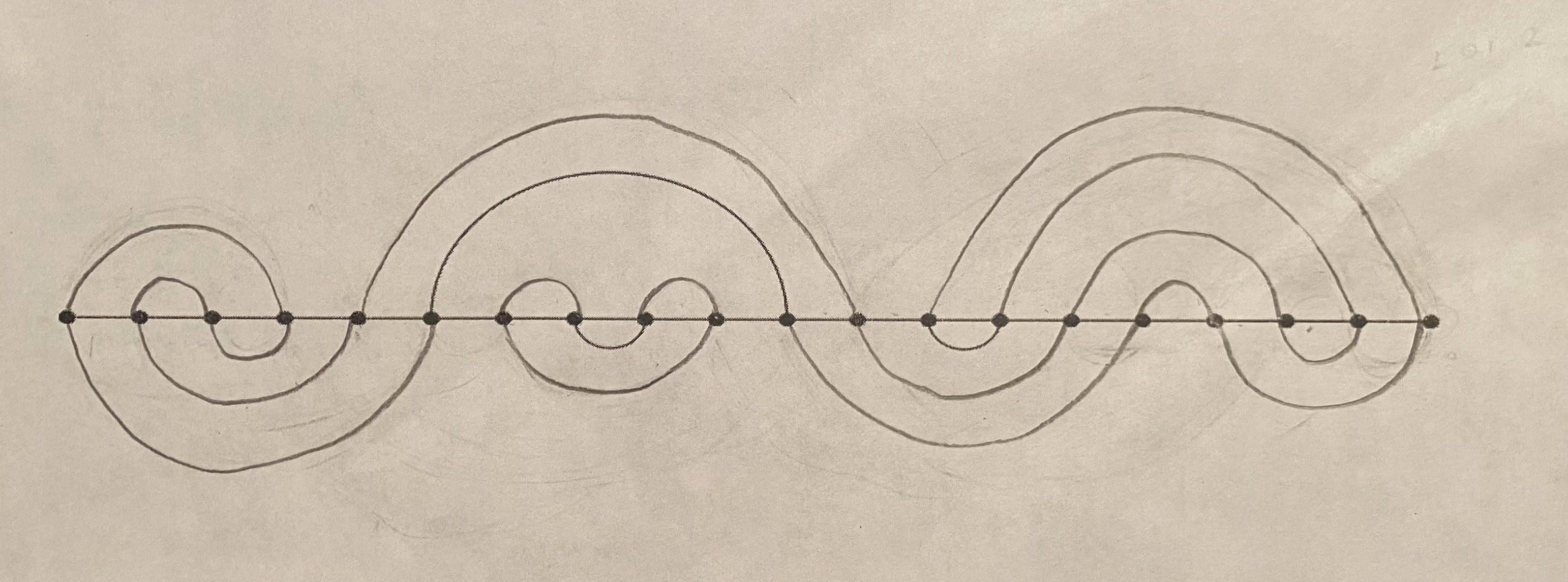
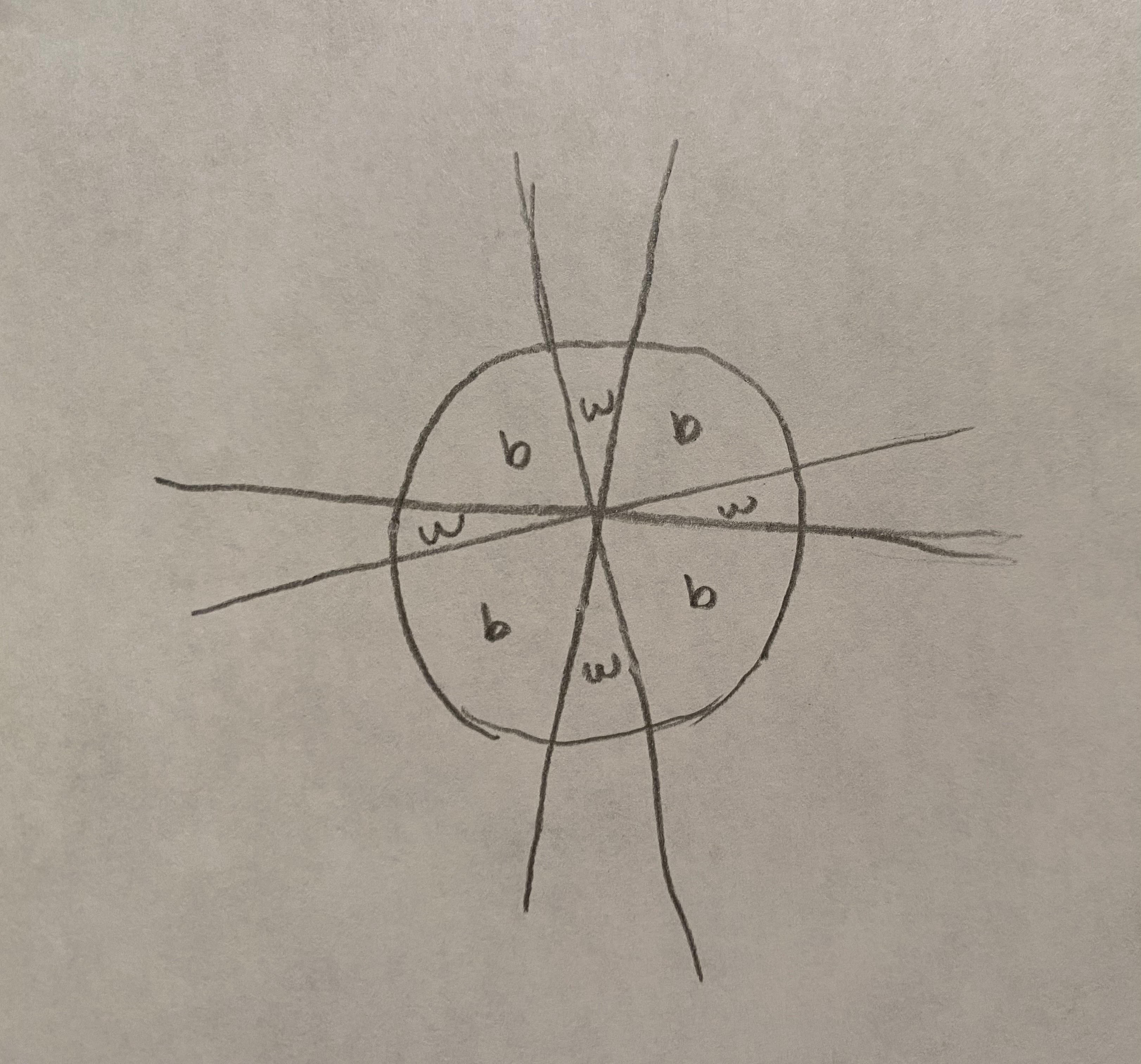
To get some spatial intuition, I used a tennis ball and rubber bands — spatial reasoning is not my strong suit. The cleanest approach is to just draw out the n = 1, 2, 3, and 4 cases. n = 1 is easy since a single great circle just divides the sphere in half. n = 2 is easy to disprove — shrink the angle between the two arcs and the areas become unequal.
For n = 4, as shown above, you can see immediately that any even n can be configured to work. I used that as the foundation to prove that odd n also works: start with an even configuration, then add another great circle and observe that the colors on one half invert while two new regions are created.
Problem 3
This one looks intimidating at first glance, and my approach was certainly not the most efficient — but I’ll walk through the better way to think about it.
So we notice that the numbers described are awfully specific, which calls for a generalization! The 1000 seems to specific. I noticed this after playing around with wolfram alpha for a bit, which I suggest you do for these types of problems. Gaining intuition. So we can generalize the $2^{1000}$ to $2^n$ and use induction which is straightforward from there.
A tidbit that is interesting to notice that if you take the expression mod $2^{12}$ let’s say, then everything from $2^{13}$ and above cancels. That is how I centered my proof, and proceeded to assume by contradiction that there is some point $2^k$ at where you can’t have 1 or 2 for that term and disprove that. It was a very long and ugly proof but it got the job done.
Problem 4
Now this problem was a woozy. For this, I used actual cards and played the game with my brother to get a sense of what was happening. After playing for a while, you can see that Grogg and Winnie will just start alternating cards at one point.
Let’s take the n = 4 scenario. So we have the cards 1, 2, 3 and 4. We know that Grogg goes first and let’s just say`that he puts down the 3 first in one pile. So Winnie’s logical move would be to put 4 next in that same pile. We see that if Grogg puts down a 3 or 4, that’s bad. To minimize this his optimal move could be to put down 1 first. Then we would have Winnie put the 4 with the 1. This leaves Grogg to put 3 in the other pile, and Winnie puts 2 with the 1 and 4. This makes a final sum of 5.
In this similar fashion, I made the grand mistake of thinking that the optimal move for Grogg was to put down a 1 first and then Winnie puts down a 50, Grogg puts a 49, Winnie puts a 48 and so on. Although! I didn’t account for the fact that no matter what Winnie will want to make sure that the 50 and 49 are in the same pile. So it’s actually Grogg’s best move to put 50 down first which is something that I totally overlooked.
From when Grogg puts down the 50, then Winnie and Grogg start to “alternate”. So I was almost there but not quite.
Problem 5
This problem was my favorite by far! It was the first one I started working on even before the puzzle.
I liked this mostly because of how straightforward it is and how simple the proofs are. Not to say that they were easy to think of, but they were really clean.
My solution here for 5b is different than the one presented in the AOPS math jam, although I think it’s pretty good. For 5a it’s quite simple to see the polynomial $n^2 + 2n + 37$ after some tinkering around with $p^2 + (p+6)^2 + n^2 + 1$ by expanding it out.
Although how to prove it’s irreducible? It’s obvious it is, but that itself is not a proof. A way of suggestion would be that the discriminant is negative or by using Einstein’s Irreducibility Criterion. I did the second one just for fun.
For 5b, I first saw that 27 was a pseudo sixish number first by just trial and error. I used wolfram alpha to make the calculations less painful and to just see straight up. This is what led me to believe it was the only pseudo sixish number because after going up to 100 or something I didn’t reach any others.
Proof Sketch:
So I wrote out the divisors of n as $(d_1)(d_2)(d_3)…(d_n)$ and then I wrote out the sum of squares of the divisors as $(d_1)^2 + (d_2)^2 … + (d_k)^2$. I wrote n as a product of some two divisors $i$ and $j$ such $n = (d_i)(d_j)$ and so $2(d_i)(d_j) + 36 = (d_1)^2 + (d_2)^2 … + (d_k)^2$. So we can write $36 = (d_i - d_j)^2 + (S_{rest})$ where $S_{rest}$ is the sum of the rest of the divisors besides $d_i$ and $d_j$, now we’ve reduced the problem to just finding the sum of squares that add up to 36.
There. The problem is simple with some casework and then you’ll find that 27 is the only pseudo sixish number.
Final Thoughts
This round felt noticeably more approachable than I expected, though I’m not complaining. Glancing at the Round 2 problems though — that’s a different story. There’s another game theory problem, and they brought back Grogg as a character. No originality with names, but then again, Grogg was my favorite character in the Beast Academy books, so I’ll let it slide.